The real reason why manual orders often remain unpaid — and how SMS payment reminders can help
Unpaid manual orders are often not lost sales. With early reminders by email and, if necessary, SMS, open orders can more often still be turned into paid revenue.

Raphael Stolz
Managing Director
Reading time: 5 minutes
Let AI summarize the post
An unpaid manual order is not yet revenue
A customer places an order in a Shopify store, chooses bank transfer, and wants to “pay quickly later.” But then the order confirmation gets buried in the inbox, the transfer is forgotten, and other invoices or purchases are handled first. A real purchase intent does not become a paid order.
Not because the customer never wanted to buy, but because the final step was not completed in time.
Why these orders often remain unpaid
Orders with manual payment methods often do not fail because of lack of demand. In many cases, the purchase intent is already there. The real problem is that payment does not happen immediately and remains open without a clear reminder process.
The reasons for this are usually unspectacular, but economically relevant: the customer forgets to pay, overlooks the email, does not immediately understand the payment information, or postpones the final step. If there is no functioning reminder flow, an almost completed conversion remains just an open order.
That is exactly why timing is crucial. From our experience with Kindly, the highest success rate is right after the order is placed. As long as the purchase intent is still fresh, the likelihood is greatest that the customer will actually complete the payment. That is why we recommend sending the first reminder as early as possible and following up with another shortly afterward.
Why SMS can be a particularly strong channel here
Even with a set up email reminder flow, customers sometimes still do not pay. Often the problem is not the offer, but that the reminder was not seen in time.
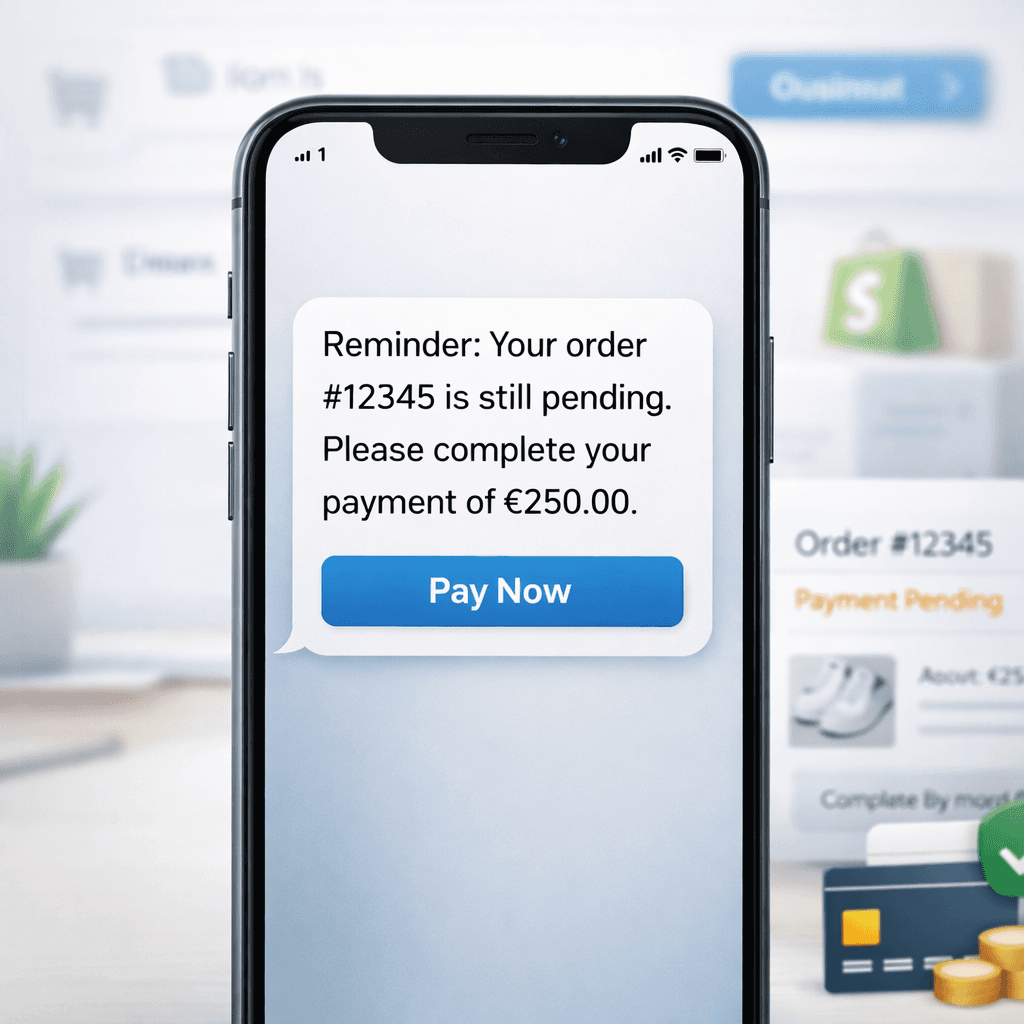
This is exactly where SMS can be especially effective. SMS is more direct, is noticed faster in many cases, and is therefore well suited for timely payment reminders. Especially when the open step fails not because of a lack of interest, but because of a lack of attention at the right moment.
In Kindly, it is also possible to check whether reminder emails were opened at all. This allows merchants to better assess whether the problem is reachability or whether the customer deliberately ignored the message. If emails are not opened, SMS can be a useful additional channel to turn more open orders into paid revenue.
For which merchants SMS payment reminders are especially useful
SMS payment reminders are not equally relevant for every Shopify store. They are especially useful where a critical step remains open between order and payment. This includes, for example:
B2B stores with invoice payments, where payments get stuck in internal approval or accounting processes
Premium stores with bank transfer, where higher cart values make an additional reminder especially worthwhile economically
Merchants with draft orders, where a customer has already shown interest but has not completed the final payment step
Stores with preorders or reserved inventory, where open orders block planning and availability
Conclusion
Unpaid manual orders are often not lost sales, but incomplete conversions. The purchase intent is already there — it just is not turned into payment in time.
With the right reminder at the right time, many of these open orders can still be turned into real revenue. And for certain Shopify merchants, SMS can be one of the most effective additional channels for that.
FAQ
Are SMS payment reminders better than email?
Not necessarily. Email remains the most important standard channel for many Shopify merchants. SMS is especially useful when reminders need to be seen quickly or emails often remain unopened. In such cases, SMS can be a very effective additional channel.
For which Shopify stores are SMS payment reminders especially worthwhile?
They are especially relevant for stores with manual payment methods such as bank transfer, invoice, or draft orders. SMS can also be worthwhile for higher cart values, B2B orders, or reserved inventory, because open orders carry greater economic weight there.
When should a payment reminder be sent?
The closer the reminder is to the order, the better the chances of a successful payment in many cases. As long as the purchase intent is still fresh, the customer is much closer to completing the purchase. That is why an early reminder is often more effective than a late follow-up message.
Are unpaid manual orders lost sales?
Not necessarily. In many cases, there is already a real purchase intent, but the final step was not completed. That is exactly why structured payment reminders can help turn open orders into paid revenue after all.
Share on social media